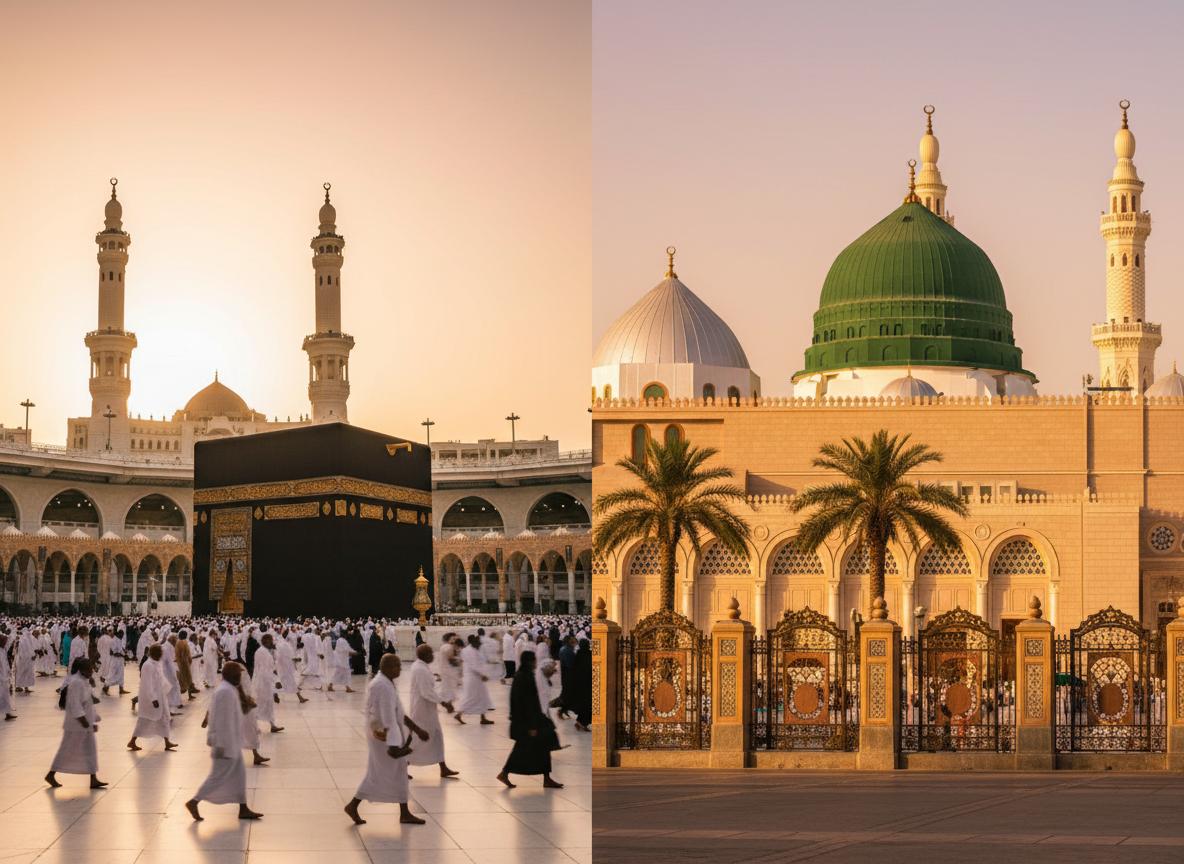
Hajj vs Umrah: Understanding the Sacred Distinctions
Published Last updated
Both Hajj and Umrah are pilgrimages to the holy city of Mecca, both involve Tawaf around the Kaaba, and both hold immeasurable spiritual reward. Yet they are distinct acts of worship, with different obligations, different timings, and different weights in Islamic law. Understanding these distinctions is essential for every Muslim planning their sacred journey.
Defining the Two Pilgrimages
Hajj is the fifth pillar of Islam — one of the five foundational obligations upon which the faith rests. It is an annual pilgrimage that takes place exclusively during the Islamic month of Dhul Hijjah, specifically on specific days (8th through 13th). Every Muslim who is physically and financially able is obligated to perform Hajj at least once in their lifetime. The Quran states: "And Hajj to the House is a duty that mankind owes to Allah, for those who can find a way" (Surah Al-Imran, 3:97).
Umrah, sometimes called the "lesser pilgrimage," is a voluntary act of worship that can be performed at any time of the year. While it is highly recommended and carries immense reward, Umrah is not obligatory under Islamic law, though many scholars consider it Sunnah Mu'akkadah (a strongly recommended Sunnah). The Prophet (PBUH) said: "From one Umrah to another is an expiation for the sins committed in between." (Bukhari and Muslim)
When Is Each Obligatory?
Hajj becomes obligatory upon a Muslim once in their lifetime when three conditions are met: they have reached the age of puberty, they are of sound mind, and they possess the financial and physical means to make the journey while meeting their family's needs in their absence. Once these conditions are fulfilled, a Muslim should not delay performing Hajj without a valid reason — the scholars are nearly unanimous that undue delay without excuse is sinful.
Umrah carries no such obligation. There is no single moment at which it "becomes due." However, if a Muslim makes a vow (nadhr) to perform Umrah, it then becomes obligatory upon them by virtue of that vow.
Key Ritual Differences
Both pilgrimages share the core rituals of Ihram, Tawaf (circumambulation of the Kaaba), and Sa'i (walking between the hills of Safa and Marwa). But Hajj includes several additional rites that are absent from Umrah:
The Standing at Arafah
The most critical rite of Hajj — and the one that distinguishes it most from Umrah — is the Wuquf (standing) at the Plain of Arafah on the 9th of Dhul Hijjah. The Prophet (PBUH) declared: "Hajj is Arafah." Missing this standing invalidates the entire Hajj. Pilgrims gather on the plain from midday until sunset, supplicating, weeping, and seeking forgiveness in what many describe as the most powerful spiritual experience of their lives. Umrah has no equivalent rite.
Muzdalifah and Mina
After Arafah, Hajj pilgrims proceed to Muzdalifah, where they spend the night under the open sky and collect pebbles for the next day's stoning ritual. They then proceed to Mina, where they stone the Jamarat (three stone pillars representing the devil) over the days of Eid al-Adha and the days of Tashreeq. Pilgrims spend up to three nights in Mina. None of these rites exist in Umrah.
The Animal Sacrifice
Hajj pilgrims who perform Tamattu or Qiran are required to offer an animal sacrifice (Hady) on the 10th of Dhul Hijjah. This commemorates the willingness of Ibrahim (AS) to sacrifice his son and is one of the most symbolically significant acts of the pilgrimage. Umrah has no associated sacrifice obligation.
Tawaf Differences
Both pilgrimages include Tawaf, but Hajj includes multiple types: Tawaf al-Qudum (arrival Tawaf), Tawaf al-Ziyarah or Ifadah (the obligatory Tawaf on 10th Dhul Hijjah), and Tawaf al-Wada (farewell Tawaf). Umrah typically involves a single Tawaf followed by Sa'i, concluding with shaving or trimming the hair.
Time and Duration
Umrah can be performed at any time of year and typically takes 2–4 hours to complete the core rituals (Tawaf and Sa'i), though pilgrims often extend their stay in the Haramayn for spiritual benefit. Full Umrah trips from Canada typically last 10–14 days, including travel and time in both Mecca and Madinah.
Hajj is strictly bound to the Islamic calendar. The pilgrimage season spans approximately 5–6 days of core ritual activity (8th–13th Dhul Hijjah), though pilgrims typically arrive several days earlier and depart several days after. Full Hajj trips from Canada generally run 21–30 days.
Cost Differences
Umrah is considerably less expensive than Hajj, primarily because Hajj packages include accommodation in Mina and Muzdalifah (which are extremely limited and therefore costly), transport between the holy sites, and the animal sacrifice. From Canada, Umrah package prices vary with season, hotel proximity to the Haram, and package inclusions.
Hajj packages from Canada generally cost considerably more, reflecting the extended duration, the logistical complexity of the Hajj season, and the Saudi government's quota system, which limits the number of pilgrims permitted from each country.
Spiritual Significance: Which Should You Do First?
If you have not yet performed Hajj and you meet the conditions of obligation, Islamic scholars are clear: Hajj takes priority. The obligation of Hajj should not be deferred in favor of Umrah. However, many Muslims who are not yet financially or physically able to perform Hajj perform Umrah in the interim — and there is great wisdom in this. Umrah serves as spiritual preparation and training for the intensity of Hajj.
For those who have already performed Hajj, Umrah becomes a means of ongoing spiritual renewal throughout life. Many scholars recommend performing Umrah during Ramadan specifically, as the Prophet (PBUH) said that Umrah in Ramadan is equivalent in reward to Hajj — or, in some narrations, to performing Hajj with the Prophet himself.
Ultimately, both pilgrimages are gifts from Allah — opportunities to stand at the most sacred place on earth, to renew your covenant with your Creator, and to return home spiritually transformed. Whether you are planning your first Umrah or preparing for the Hajj of a lifetime, approach both with the same intention: total sincerity, complete presence, and an open heart.
Plan Your Sacred Journey with Confidence
Whether you're ready for Hajj or preparing for your first Umrah, our team helps Canadian Muslim families navigate every step — from visa applications to spiritual preparation. Hold a Pakistani passport and NICOP? Read about Hajj from Canada on a Pakistani passport.
Frequently Asked Questions
It's my first Umrah. Will someone guide me through the rites?
Yes. Larger groups travel with an Arabic- and English-speaking guide from Canada; smaller groups and individual pilgrims are supported by our ground team in Saudi Arabia. Our Journal guides to Ihram and Tawaf help you prepare before you go.
How long are your Umrah packages?
Our standard Umrah packages run 7–8, 10–12 or 14–15 days, and our Ramadan packages run 10 or 14 days. Because our Umrah packages are tailor-made, we can adjust the length to your dates.
When can Umrah and Hajj be performed?
Umrah can be performed at any time of the year. Hajj takes place only during the Islamic month of Dhul Hijjah, with the core rites from the 8th to the 13th of the month.
Why does Hajj cost more than Umrah?
Hajj packages include accommodation in Mina and Muzdalifah, which is extremely limited and therefore costly, transport between the holy sites, and the animal sacrifice. Prices also reflect the longer stay, the logistical complexity of the Hajj season, and the Saudi government's quota system, which limits the number of pilgrims permitted from each country.