The Spiritual Significance of Tawaf
Published Last updated
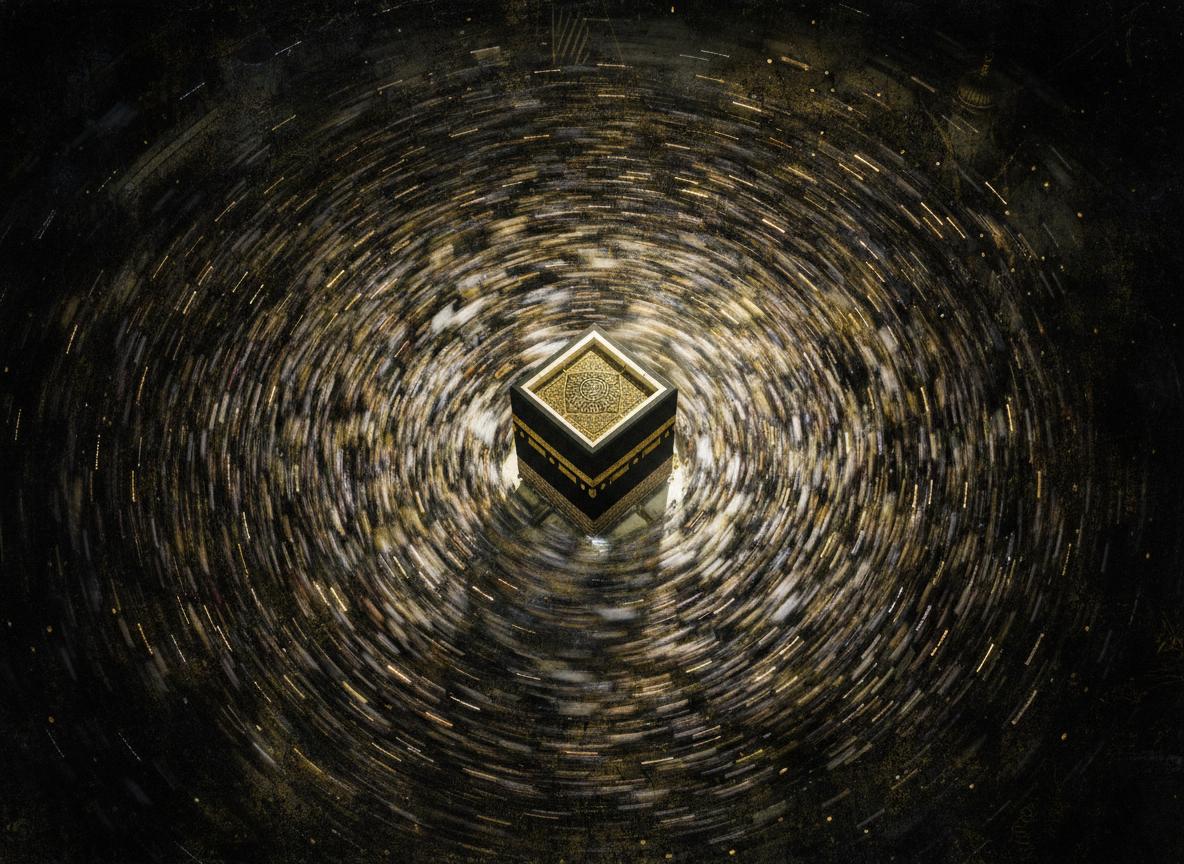
When you first see the Kaaba, something happens to time. The crowd fades into peripheral noise. Your breath slows. And then, inexplicably, you find yourself moving — joining the vast, silent river of white that circles the House of Allah in an ancient rhythm that has never stopped. This is Tawaf. And it is one of the most profound acts of worship in Islam.
What Is Tawaf?
Tawaf is the ritual circumambulation of the Kaaba — the cube-shaped structure at the center of Al-Masjid Al-Haram in Mecca that Muslims believe to be the first house built for the worship of Allah on earth. The word comes from the Arabic root meaning "to go around" or "to encompass." A single Tawaf consists of seven circuits, each beginning and ending at the Black Stone (Hajar al-Aswad) set into the eastern corner of the Kaaba.
Tawaf is performed counterclockwise — with the Kaaba on your left at all times. This direction is not arbitrary. The entire cosmos orbits in patterns: electrons around nuclei, planets around stars. The angels make Tawaf around the Bayt al-Ma'mur — the celestial counterpart of the Kaaba in the seventh heaven. When you perform Tawaf, you are joining a cosmic act of worship that extends far beyond what the human eye can see.
The Hajar al-Aswad: The Black Stone
Each circuit of Tawaf begins and ends at the Hajar al-Aswad — the Black Stone — which is embedded in the eastern corner of the Kaaba at approximately shoulder height. The Prophet (PBUH) said of it: "The Black Stone descended from Paradise, and it was whiter than milk, but the sins of the children of Adam turned it black." (Tirmidhi)
When possible, pilgrims kiss the Black Stone in the manner of the Prophet (PBUH). However, in the crowds of modern Hajj and Umrah, this is often not possible. The accepted alternatives are to touch it with the hand, or simply to face it and gesture toward it (Istilam) with the right hand while saying Bismillah, Allahu Akbar. The spiritual intention is what matters — the Istilam acknowledged from a distance carries the same blessing as the touch.
Sayyiduna Umar ibn al-Khattab (RA) famously said while kissing the Black Stone: "I know that you are just a stone that can neither harm nor benefit. And had I not seen the Prophet (PBUH) kiss you, I would not have kissed you." This narration reminds us that Tawaf is pure obedience — performed not because we understand every dimension of its wisdom, but because Allah commanded it and His Prophet showed us how.
The Seven Circuits: A Framework for Dua
There is no single prescribed dua for Tawaf — one of the great gifts of this ritual is that it is a wide-open space for personal supplication. The Prophet (PBUH) recommended reciting Rabbana atina fid-dunya hasanatan wa fil-akhirati hasanatan wa qina 'adhab an-nar between the Yemeni Corner and the Black Stone, but the remaining time in each circuit is yours to fill.
Many scholars and teachers suggest using the seven circuits as a structured framework for your dua:
Begin with glorification. Open your heart. You are circling the House of Allah — let the magnitude of that reality sink in as you take your first steps.
Send salawat upon the one who brought us this path. Reflect on his love for the Ummah and the weight of the prophethood he carried.
This is the circuit of repentance. Bring to mind your sins and shortcomings with sincerity. The gate of forgiveness is open wider at the Kaaba than anywhere on earth.
Make dua for those who raised you — living and departed. Ask Allah to envelop them in His mercy, to forgive their sins, and to reunite you with them in Jannah.
Expand your circle of supplication. Pray for your spouse, your children, your siblings. Pray for your wider Muslim community. You carry them with you around this Kaaba.
Widen further. Pray for Muslims suffering across the world. Pray for unity, for relief from oppression, for the guidance of those who have strayed.
The final circuit is yours entirely. Ask Allah for whatever is in your heart — your deepest hopes, your hidden fears, your most private longing. He knows, and He responds.
Orbiting Allah: The Deeper Meaning
The great scholar Ibn al-Qayyim wrote that the Tawaf is the body's expression of the heart's perpetual orientation toward Allah. The heart of the believer should always revolve around the love of Allah — in ease and in hardship, in joy and in grief. Tawaf makes that inner orbit visible, physical, communal. Millions of hearts, in the same motion, expressing the same orientation.
There is also a profound connection to our father Ibrahim (AS). It was Ibrahim and his son Ismail (AS) who rebuilt the Kaaba — raising its foundations as described in Surah al-Baqarah — and it is Ibrahim whom Allah commanded to call humanity to Hajj. Allah told him: "Proclaim the Hajj to all people, and they will come to you on foot and on every lean camel, coming from every distant mountain path." (22:27)
Every Tawaf you perform is a response to that ancient call. You are here because Ibrahim called, and your soul answered across millennia.
The Three Types of Tawaf in Hajj and Umrah
Tawaf al-Qudum (Arrival Tawaf)
Performed upon first arriving in Mecca during Hajj, this is the greeting Tawaf — your first encounter with the Kaaba after perhaps a lifetime of longing. It is Sunnah for those performing Ifrad or Qiran Hajj. For those performing Tamattu, the Umrah Tawaf serves this purpose. Tawaf al-Qudum is characterised by Raml — a slightly brisk, purposeful pace — in the first three circuits, a practice established by the Prophet (PBUH).
Tawaf al-Ziyarah / Ifadah (The Obligatory Tawaf)
The most important Tawaf in Hajj, performed on the 10th of Dhul Hijjah after returning from Arafah and Muzdalifah. This Tawaf is a Rukn (pillar) of Hajj — it is obligatory and its omission, without valid excuse, invalidates the Hajj. It is the Tawaf that marks the central culmination of the pilgrimage, the moment when the pilgrim returns to the House of Allah after the great spiritual climax of Arafah.
Tawaf al-Wada (Farewell Tawaf)
The final act of Hajj before departing Mecca is Tawaf al-Wada — the farewell circumambulation. The Prophet (PBUH) instructed that no pilgrim should leave Mecca without their last act in the Haram being Tawaf. This is one of the most emotionally charged moments of the pilgrimage: you are saying goodbye to the Kaaba, not knowing if you will return. Many pilgrims weep openly during this Tawaf. The farewell is a reminder that this world is always temporary — we pass through its sacred places as guests, and we carry the spirit of those encounters with us into the life that continues beyond.
Experience Tawaf for Yourself
No amount of reading fully prepares you for the moment you first see the Kaaba. Our guides accompany you from your first circuit to your farewell Tawaf — helping you understand each rite so that every step is filled with meaning.
Frequently Asked Questions
What is the Kaaba?
The Kaaba is the cube-shaped structure at the center of Al-Masjid Al-Haram in Mecca that Muslims believe to be the first house built for the worship of Allah on earth.
What is Tawaf?
Tawaf is the ritual circumambulation of the Kaaba. The word comes from the Arabic root meaning "to go around" or "to encompass." A single Tawaf consists of seven circuits, each beginning and ending at the Black Stone (Hajar al-Aswad).
Where is the Black Stone?
The Hajar al-Aswad, the Black Stone, is embedded in the eastern corner of the Kaaba at approximately shoulder height.
What are the three types of Tawaf in Hajj?
Tawaf al-Qudum, the arrival Tawaf; Tawaf al-Ziyarah or Ifadah, performed on the 10th of Dhul Hijjah after returning from Arafah and Muzdalifah; and Tawaf al-Wada, the farewell Tawaf before leaving Mecca.